Post-Operative Hypothermia in Veterinary Patients: Risks, Prevention, and Recovery Cage Warming
Why perioperative hypothermia is the most underestimated complication in veterinary surgery, how forced-air warming works, and how to maintain warming through recovery cage transfer.
The Most Common Surgical Complication Nobody Talks About
If you asked most veterinary staff to name the biggest risk during surgery, they’d probably say hemorrhage, anesthetic overdose, or cardiac arrest. Almost nobody says hypothermia. Yet heat loss starts in the first hour of anesthesia in essentially every patient, and the Merck Veterinary Manual lists hypothermia among the things that make emergency and surgical patients worse, not better.
Hypothermia is a body temperature below the patient’s normal range. The Merck Veterinary Manual lists normal rectal temperature as 37.5 to 39.2°C (99.5 to 102.5°F) in dogs and 38.1 to 39.2°C (100.5 to 102.5°F) in cats. Quandt, writing in Today’s Veterinary Practice, gives a slightly different cat range (37.8 to 39.5°C) and grades hypothermia in dogs and cats by how far the temperature has fallen:
- Mild: 37.0 to 37.7°C (98.6 to 99.9°F)
- Moderate: 35.8 to 37.0°C (96.4 to 98.6°F)
- Severe: 33.6 to 35.8°C (92.5 to 96.4°F)
- Critical: Below 33.6°C (92.5°F)
Those are the bands as Quandt publishes them, and the boundaries are shared between adjacent grades in the source (37.0°C appears in both mild and moderate, for example), so treat a reading on a boundary as a judgment call. The Celsius figures are the source’s; we converted to Fahrenheit exactly rather than using the source’s rounded values. Note too that the top of the mild band sits inside the low end of the published normal ranges, and Merck’s emergency chapter uses yet another number, warming shock patients until rectal temperature is above 36.5°C. Thresholds depend on the measurement method, the species, whether the patient is under anesthesia, and your facility’s protocol; these bands are a published reference, not a universal treatment protocol.
Most surgical patients don’t hit severe or critical. But mild to moderate hypothermia is common without intervention, and it still matters.
How Anesthetized Patients Lose Heat
Quandt describes three phases of heat loss under anesthesia. In the first hour, a rapid decline comes from peripheral vasodilation and redistribution of body heat from the core to the periphery. Over the following two hours, temperature keeps falling in a slower, roughly linear fashion. Over the next three to four hours, core temperature stabilizes and stays relatively unchanged.
Heat physically leaves the body through radiation to cooler surroundings, convection into moving air, evaporation from open body cavities and wet fur, and conduction into cold surfaces like a steel table. Merck singles out small, young, and old animals as the patients most vulnerable to hypothermia.
What Hypothermia Actually Does to the Patient
This isn’t just a number on the monitor. Merck’s emergency chapter puts it plainly: hypothermia “can be detrimental in several ways, including shock (especially in cats), impaired drug metabolism, impaired wound healing, and abnormal coagulation.”
Two of those matter most in the hours after surgery. Impaired drug metabolism means anesthetic agents aren’t cleared at the expected rate, so recovery drags on. Abnormal coagulation and impaired wound healing are exactly the things a fresh surgical patient can least afford.
What Works for Warming (and What Doesn’t)
The options aren’t all equal, and not all of them are safe.
Quandt divides warming into passive and active. Passive warming uses external wraps, blankets, or towels to slow heat loss while the patient generates its own warmth. Active surface warming adds heat: a forced hot air warmer, a water-circulating blanket, towels or blankets around the patient, or socks on the paws. Active core warming (warm saline lavage into a body cavity) is an intensive-care measure, not a recovery ward one.
Merck’s emergency chapter says warming “is best accomplished by increasing the environmental temperature using warm air blowers, warm water blankets, and IV fluid warmers; however, the effectiveness of some of these techniques has not been clearly demonstrated.” It adds a hard rule: “Hot water bottles and hot rice bags should be avoided because of potential burn risk.”
A few more cautions from Quandt. Warmed IV fluids should not be hotter than 42.6°C (108°F). Heat lamps belong more than 30 inches from the patient, and a patient under one should not be left unattended. Forced-air warming blankets placed too near a surgical field have been associated with infection, so blanket placement and isolation of the surgical field matter. And a forced-air unit has its own rules: the 3M Bair Hugger operator’s manual says not to treat patients with the hose alone, to always attach the hose to a 3M warming blanket or gown, and not to let the hose contact the patient’s skin.
Most clinics combine more than one method. Which ones, and when, is a decision for your veterinarian and your facility’s protocol.
Where the Warming Chain Breaks
Here’s where the problem actually lives for most clinics. The surgery goes well. The patient gets warmed intraoperatively with a forced-air blanket, warm water pad, maybe heated fluid lines. Then the case ends, and the patient moves to a recovery cage.
The warming stops. The cage is room temperature. The stainless steel floor and walls conduct heat away from the patient. The anesthetic is still wearing off, so the patient is still in the window Quandt describes, losing heat rather than regaining it. The patient cools further at exactly the moment they should be warming up.
This gap between the OR and the recovery cage is the most fixable part of the whole problem.
The Improvisation Problem
The reason clinics don’t continue warming through recovery is simple: the Bair Hugger hose doesn’t fit through a closed cage door. So staff get creative.
Towels wedged in the cage door to hold it partially open. The hose threaded through the bars at an angle that kinks it and cuts airflow. A bare hose end pointed into the cage, which the manufacturer’s manual specifically warns against. Tape holding everything together until a groggy 30-kilogram dog bumps into it.
A propped-open cage door is an escape risk for any dysphoric post-anesthetic patient. A kinked hose defeats the purpose of the warming unit. Tape on stainless steel doesn’t hold under any real stress. These workarounds persist because no manufacturer provided a better option, and they become so routine that people stop thinking of them as problems.
How a Cage Passthrough Adapter Solves This
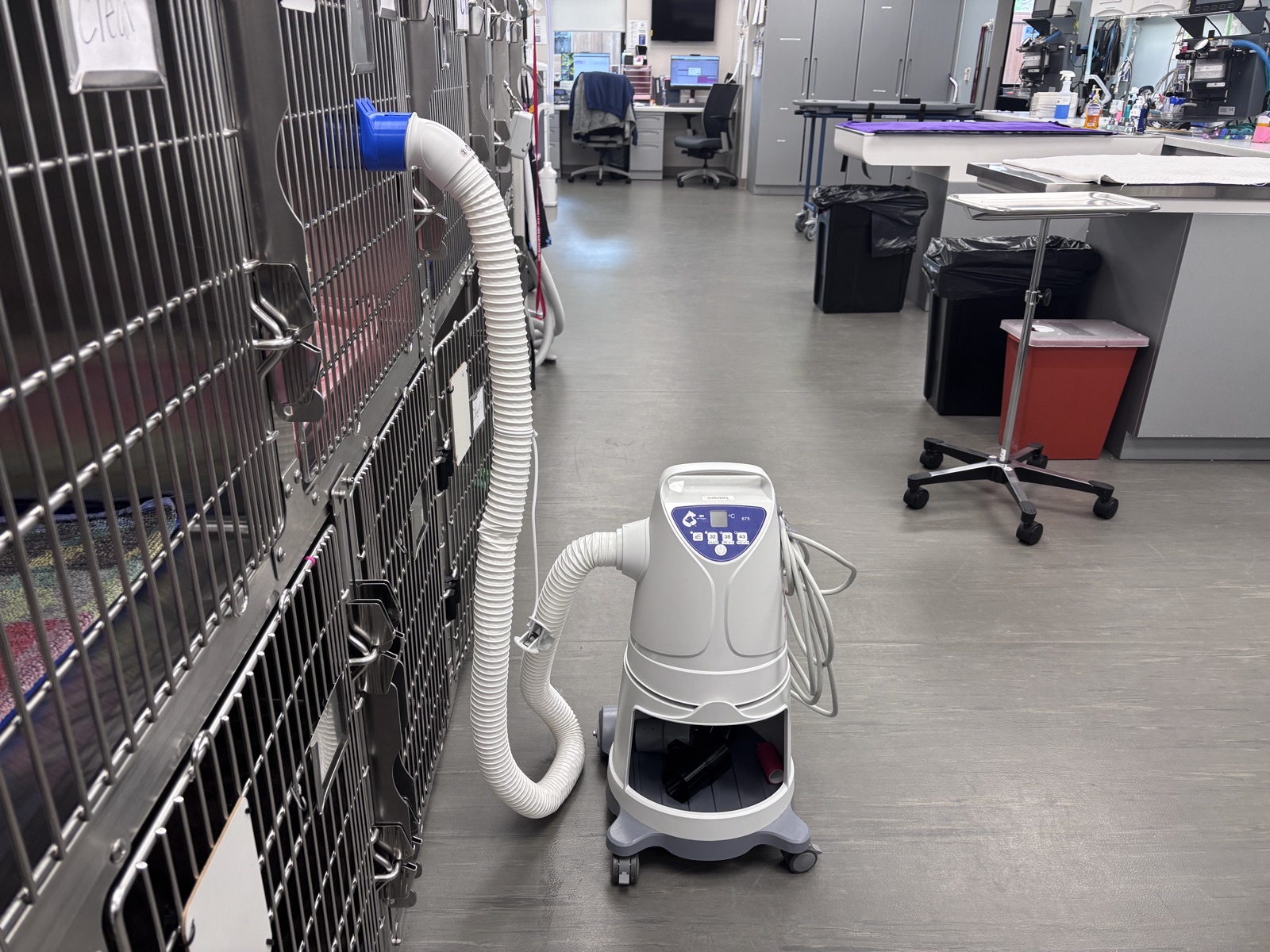
A cage passthrough adapter seats into the ventilation slot of a standard veterinary cage door, creating a sealed port that routes the warming hose from outside the cage to inside. The cage door closes and latches fully. No propped doors, no kinked hoses, no escape risk.
Inside the cage, the hose still connects to a 3M warming blanket or gown on the patient. The Bair Hugger manual says not to treat with the hose alone and not to let the hose touch the patient, and the adapter doesn’t change that; it only changes where the hose passes through the door. It fits the 3M Bair Hugger Model 675 hose and seats into Shor-Line stainless steel cage systems and standard stainless recovery cage doors. It is an accessory, not affiliated with or endorsed by 3M.
What About Large Patients in Cage Runs?
The biggest recovery patients (post-orthopedic, abdominal surgery, giant breeds) go into floor-to-ceiling cage runs, typically 78 inches tall. These are also the patients who’ve often been under anesthesia the longest.
Standard cage adapters are sized for compact cage bank doors. Runs are taller, wider, and have different gate configurations. A cage runs extension connects onto the base passthrough adapter to cover the greater distance, so one base adapter plus one extension handles both cage types in your facility.
The full lineup is on the Bair Hugger Ecosystem page.
Thinking About the Whole Journey
A warming plan covers the entire surgical journey, not just the time on the table. The published sources above give a few anchors for it, and your facility’s protocol fills in the rest:
- Know the phases. Quandt’s first-hour redistribution drop means the biggest loss happens early, and the plateau three to four hours in means a cold patient won’t simply warm back up on its own.
- Warm with the right tools. Warm air blowers, warm water blankets, and IV fluid warmers are the methods Merck names; hot water bottles and rice bags are the ones it says to avoid.
- Rewarm at a measured pace. Quandt gives a target rewarming rate of 1.1 to 2.2°C (about 2 to 4°F) per hour, warming the trunk, chest, and abdomen rather than the extremities to reduce afterdrop.
- Keep the warmer running through recovery with a cage passthrough adapter, with the hose attached to a blanket or gown as the manufacturer directs.
- Monitor, and let your protocol decide the endpoints. How often to check temperature, what number counts as normothermic, and when a patient is warm enough to discharge are decisions for your veterinarian and your written protocol, not this article.
Every gap in this chain is a window for the temperature to drop further.
The Bottom Line
Hypothermia during and after surgery isn’t inevitable. The tools to prevent it exist. The piece most clinics are still missing is the transition from OR to cage, and that’s a mechanical problem with a straightforward fix.
For more on monitoring during anesthesia, see our capnography and ETCO2 monitoring guide. For a broader look at clinic equipment gaps, see 7 common veterinary clinic equipment problems.
Sources
- Merck Veterinary Manual, Normal Rectal Temperature Ranges table (dogs 37.5 to 39.2°C, cats 38.1 to 39.2°C). Merck Veterinary Manual
- Linklater A. Initial Triage and Resuscitation of Small Animal Emergency Patients. Merck Veterinary Manual, last updated April 2026 (effects of hypothermia, warming methods, hot water bottle caution, 36.5°C rewarming target in shock). Merck Veterinary Manual
- Quandt J. Hypothermia in the Operating Room. Today’s Veterinary Practice, 2018 (normal ranges, hypothermia grades, three phases of heat loss, warming methods and cautions, rewarming rate). Today’s Veterinary Practice
- 3M Bair Hugger Warming Unit Model 675 Operator’s Manual, 34-8727-8204-9, rev. 8 (hose and blanket warnings). Manufacturer document
This article is for informational purposes only. VetBog products are accessories, not affiliated with or endorsed by 3M. Always follow your facility’s clinical protocols and your warming unit’s instructions for use. Brand names are trademarks of their respective owners, used for equipment identification under nominative fair use.
Temperature thresholds vary between references and depend on measurement method, species, anesthesia status, and facility protocol; follow your facility’s protocol.
Frequently Asked Questions
What temperature is considered hypothermic in dogs and cats?
Hypothermia is a temperature below the normal range, which the Merck Veterinary Manual gives as 37.5 to 39.2°C (99.5 to 102.5°F) for dogs and 38.1 to 39.2°C (100.5 to 102.5°F) for cats. One published grading (Quandt, Today’s Veterinary Practice) calls 37.0 to 37.7°C (98.6 to 99.9°F) mild, 35.8 to 37.0°C (96.4 to 98.6°F) moderate, 33.6 to 35.8°C (92.5 to 96.4°F) severe, and below 33.6°C (92.5°F) critical. Thresholds vary between references and with measurement method, species, and anesthesia status, so follow your facility’s protocol.
How fast should a hypothermic patient be rewarmed?
Quandt gives a target rewarming rate of 1.1 to 2.2°C (about 2 to 4°F) per hour, warming the trunk, chest, and abdomen rather than the extremities to limit afterdrop. Merck’s emergency chapter adds that in shock patients, surface warming starts only after initial volume resuscitation. How long that takes for a given patient depends on how cold they are, the method, and your protocol.
Can I use a Bair Hugger in a closed recovery cage?
Not without an adapter. The hose doesn’t fit through a closed cage door. A cage passthrough adapter creates a sealed port in the ventilation slot so the hose routes through to a 3M blanket or gown on the patient while the door closes and latches normally. The unit is still used as the manufacturer directs: hose attached to a blanket or gown, never in contact with the patient.
Do warm water blankets work for recovery cage warming?
Quandt lists water-circulating blankets among the active surface warming options, and Merck names warm water blankets alongside warm air blowers and IV fluid warmers, with the caveat that the effectiveness of some warming techniques has not been clearly demonstrated. The practical question in a cage is contact: a water blanket only warms what lies on it. Whether it is enough on its own, or a supplement to forced air, is a call for your veterinarian.